Immune to Oversight: How CGIS Leadership Escapes Accountability
The most dangerous failure inside the Coast Guard Investigative Service (CGIS) is not any single program, policy, or personality. It is the system that allows leadership failure to persist without consequence—shielded by silence, rotation, and institutional reluctance to confront itself.
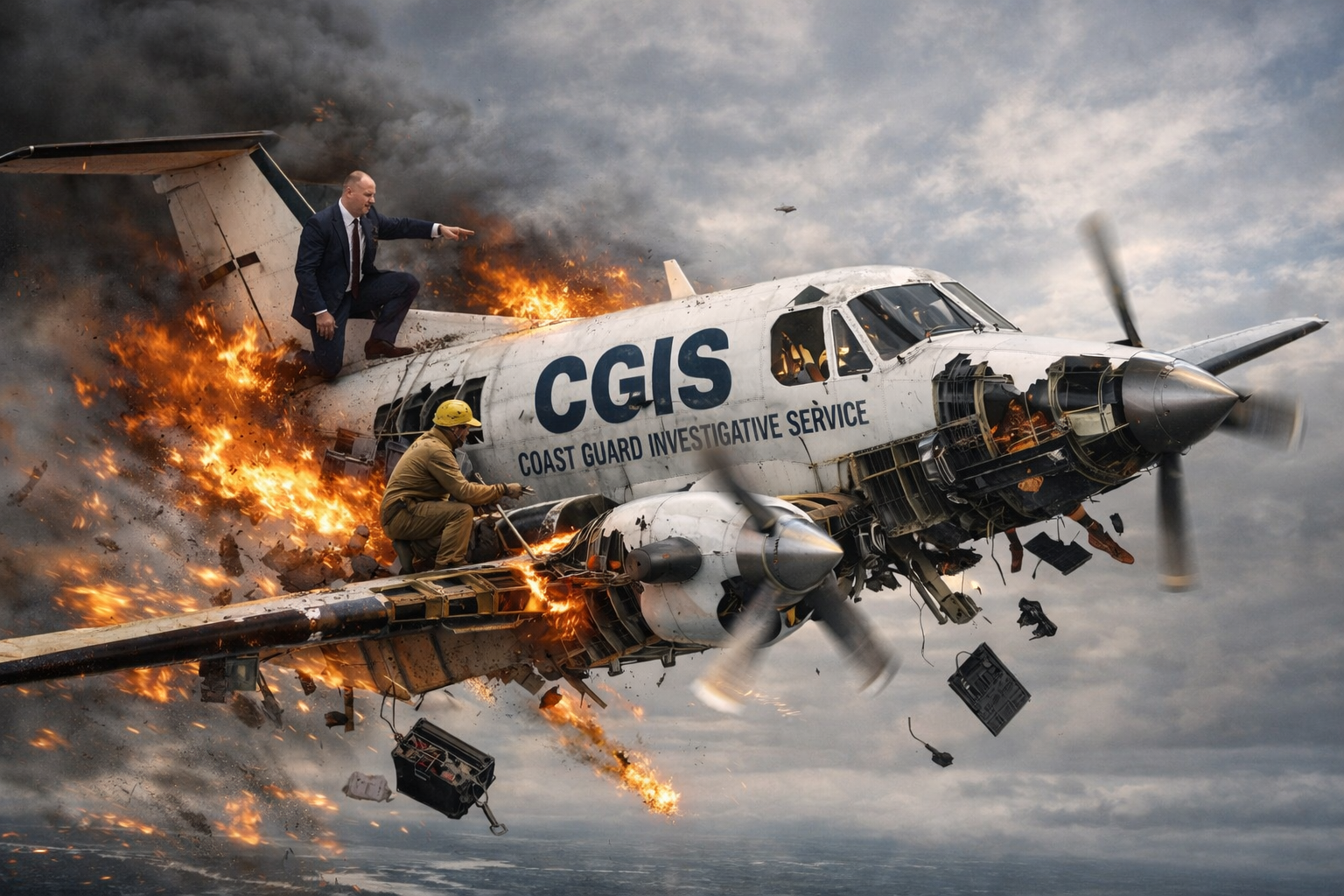
CGIS today operates with a form of executive immunity. Oversight exists on paper, but accountability dissolves in practice. Warnings are acknowledged, then ignored. Guardrails are announced, then quietly removed. Each time scrutiny approaches, leadership resets—not through correction, but through turnover above them.
The result is an organization trapped in a cycle where the same mistakes recur, the same harms deepen, and the same leaders remain untouched.
Warnings Recognized—Then Abandoned
The Coast Guard was not blind to the problems inside CGIS.
Years of Defense Equal Opportunity Climate Survey (DEOCS) results documented a collapse in morale and trust. In one reporting cycle alone, more than 75 pages of negative comments focused squarely on senior CGIS leadership—specifically the Director. The feedback was so significant that the Deputy Commandant for Operations (DCO) himself acknowledged the risk and established what were described as “guardrails” for the Director’s conduct and decision-making.
That acknowledgment mattered. It was an admission that oversight was necessary and that unchecked authority had already caused harm. But those guardrails proved temporary.
Shortly after their establishment, the DCO retired. With that departure, meaningful supervision ended. The Director was no longer managed by an independent senior leader willing to impose constraints, but instead fell under the purview of the DCO–Deputy— a close confidant and ally. Where caution had briefly existed, deference replaced it. Where oversight had been asserted, protection followed.
The freeway widened. The guardrails disappeared. From that point forward, the Director operated with renewed freedom—despite unchanged conditions, unresolved findings, and a workforce already signaling distress.
A History Ignored by Design
This failure did not begin with one survey cycle or one change in command. Years earlier, a Department of Homeland Security Office of Inspector General (OIG) assessment identified many of the same structural problems still present today: unclear policy frameworks, centralized decision-making, leadership disconnect from the field, and inadequate accountability mechanisms. Those findings were not theoretical—they were explicit warnings about how CGIS was being managed and where it would fail if corrective action was not taken.
When the current Director reported, there was an opportunity—perhaps the most important one—to pause and learn. That opportunity was not taken.
There was no comprehensive review of historical OIG findings to determine whether corrective actions had been implemented. No effort to analyze past DEOCS data to understand workforce sentiment trends. No deliberate assessment of existing leadership, field competence, or institutional strengths. Instead of listening first, the Director assumed he already understood the organization and its needs.
Immediate change followed—fast, sweeping, and poorly grounded. The Director pursued a “build the plane while it flies” model of reform, introducing major structural changes without conducting a deliberate assessment of organizational history, readiness, or known risk factors. Crucially, many of those changes replicated the very behaviors the OIG had warned against.
Policy by Email, Multiplied
Not only did the Director cancel all existing policy—declaring that the sole CGIS policy manual would no longer be recognized—but he did so without having a replacement ready for implementation. All Director’s Notes issued by the prior Director were also rescinded. In a single stroke, CGIS lost what little formal policy structure it had, along with the historical guidance that had filled critical gaps for years.
The result was immediate and destabilizing. The organization was left without authoritative direction, forced into a prolonged state of uncertainty—awaiting standard operating procedures that were promised but released only in fragments, one section at a time. Rather than approve and implement workable guidance, the Director routinely delayed decisions for months, and in some cases years. This pattern reflected not prudence, but an unwillingness to accept responsibility for outcomes, leaving the workforce paralyzed while leadership deferred accountability.
Into that vacuum came one of the most visible and damaging developments: the explosion of “policy by email.” Rather than consolidating guidance into a coherent, accessible manual—despite the 2017 OIG assessment explicitly criticizing this practice—CGIS leadership dramatically expanded it. Director’s Notes were replaced by Director ICON messages, and rules, interpretations, and expectations were issued piecemeal, without integration, formal revision, or meaningful input from field leadership. Prior guidance was rescinded wholesale, not refined.
What had once been identified as a weakness became a defining feature. Today, CGIS agents routinely preserve emails as their only reliable policy reference. There is no authoritative manual to consult. No single source of truth. Expectations shift without notice, and compliance depends entirely on an agent’s ability to locate or recall the latest message buried in an inbox.
This is not modernization. It is institutional disarray.
And it mirrors—almost precisely—the dysfunction identified years earlier, now amplified rather than corrected.
Oversight Reset by Rotation
Perhaps the most corrosive mechanism enabling all of this is leadership rotation above CGIS. Each time senior Coast Guard Flag officers change, accountability resets. Concerns raised with one DCO do not carry forward to the next. Guardrails imposed by one leader are not enforced by their successor. The Director effectively receives a clean slate—not because conditions have improved, but because continuity of oversight does not exist.
This structure allows leadership failure to outlast scrutiny. Problems are reframed as legacy issues. New Flag officers are briefed with optimism and assurances of progress. The same narratives are recycled. Meanwhile, unresolved issues deepen, and the workforce absorbs the consequences.
Oversight does not fail due to lack of information. It fails because intervening would require sustained attention, institutional memory, and the willingness to confront uncomfortable truths.
Rule by Intimidation, Not Followership
As trust collapsed, CGIS leadership did not recalibrate—it consolidated power. With no sustained external oversight and no internal accountability mechanisms that carried consequence, authority replaced credibility. Decision-making narrowed, dissent was managed rather than addressed, and responsibility was increasingly deflected upward or outward.
This was not leadership through followership. It was governance through containment. Operational authority became centralized at Headquarters, not to improve outcomes, but to control risk exposure. Messaging shifted. Commitments were reworded. Statements were quietly walked back. Guidance changed without acknowledgment. In this environment, challenging inconsistencies carried personal risk, while compliance—regardless of merit—became the safest course.
The accumulation of EEO complaints, civil rights concerns, and documented policy violations did not trigger corrective action; instead, they were absorbed as background noise. Not because they lacked substance, but because no mechanism existed—or was allowed—to compel accountability. Patterns replaced incidents, and patterns were tolerated.
Today, confidence in CGIS executive leadership is functionally absent across the field. Special Agents in Charge, Assistant Special Agents in Charge, and Supervisory Special Agents no longer rely on Headquarters messaging as authoritative or durable. Integrity, once the basis of command trust, has been eroded by contradiction and inaction.
What remains is compliance driven not by belief in leadership, but by the understanding that resistance is punished and silence is survivable. This is not a failure of morale alone—it is the predictable outcome of an organization where oversight is temporary, consequences are optional, and leadership is insulated from the effects of its own decisions.
Awareness Without Action Is Endorsement
The Coast Guard cannot credibly claim ignorance. Senior leaders are aware of multiple DEOCS results. Aware of historical OIG findings and ongoing OIG concerns. Aware of unresolved complaints. Aware of attrition, morale collapse, and operational instability. Choosing not to act in the face of that knowledge is not neutrality—it is endorsement.
Allowing leadership to continue under these conditions sends a clear message: accountability applies everywhere except at the top. That message does lasting damage. It tells the workforce that raising concerns is futile. It tells agents that integrity is optional at senior levels. It tells the organization that change is measured by activity, not outcomes.
The Cost of Immunity
CGIS is not better off today than it was when the current Director arrived. It is demonstrably worse. Recovery will take years—not because the workforce lacks capability, but because trust has been broken and institutional knowledge has been dismissed. Programs can be rebuilt. Policies can be rewritten. But credibility, once lost, is far harder to restore.
The Coast Guard prides itself on accountability, professionalism, and leadership under pressure. Allowing CGIS to operate immune to oversight undermines those values—and places the service’s only criminal investigative arm at risk of further collapse.
Oversight that does not lead to accountability is not oversight at all.
It is theater.
And the consequences of that theater are borne not by executives, but by the agents tasked with protecting the Coast Guard—and the public it serves.
2017 OIG Assessment of CGIS Findings
1. Lack of cohesive investigative policy framework.
The OIG cited fragmented guidance and overreliance on informal direction.
2. Centralized decision-making detached from field operations.
Leadership failed to delegate authority or empower field offices.
3. Inadequate supervisory structure and leadership development.
Supervisory roles lacked training, authority, and consistency.
4. Poor communication and transparency from Headquarters.
Guidance was unclear, frequently reversed, or undocumented.
5. Failure to address morale and workforce trust.
Climate concerns were documented but not meaningfully acted upon.
6. Absence of sustained accountability mechanisms.
Oversight findings lacked enforcement or follow-through.
7. Leadership resistance to external oversight.
Defensive posture toward OIG and internal critics persisted.
8. Failure to institutionalize corrective action.
Lessons identified were neither tracked nor implemented.